Housing a Glass Plate Negative

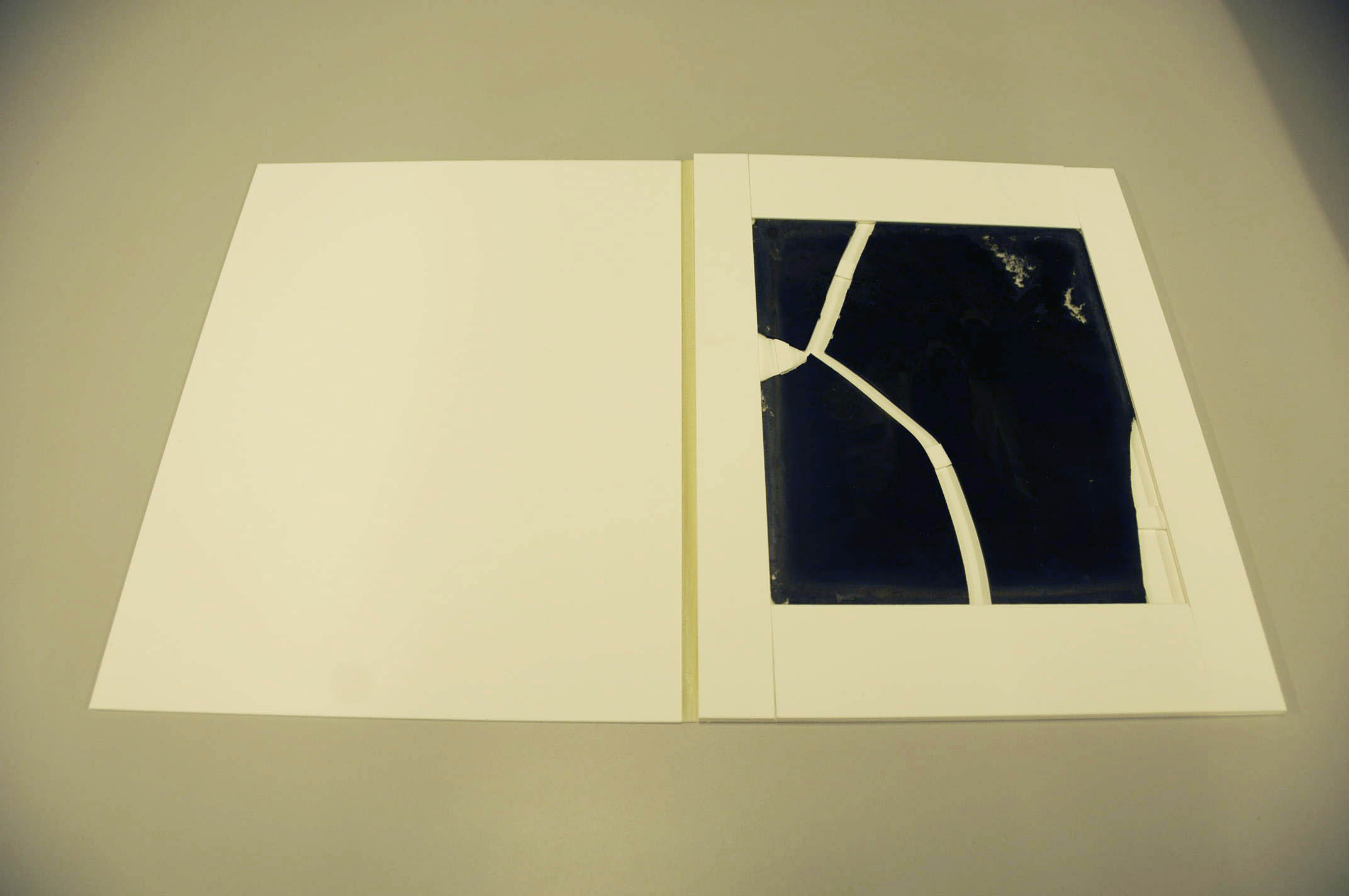
Though our conservation lab at TSLAC focuses primarily on books and paper, we also care for the non-paper-based archival items found in our collections.  This month, we created a housing for an undated photographic glass plate negative from the Sam Houston Regional Library and Research Center in Liberty, TX.

A glass plate negative consists of photographic emulsion cast on a glass plate.  The negative image on the plate is later developed into a photographic print.  Glass makes these negatives very fragile.  When they break, their fractured edges begin to abrade one other, causing more damage to the glass and the media.

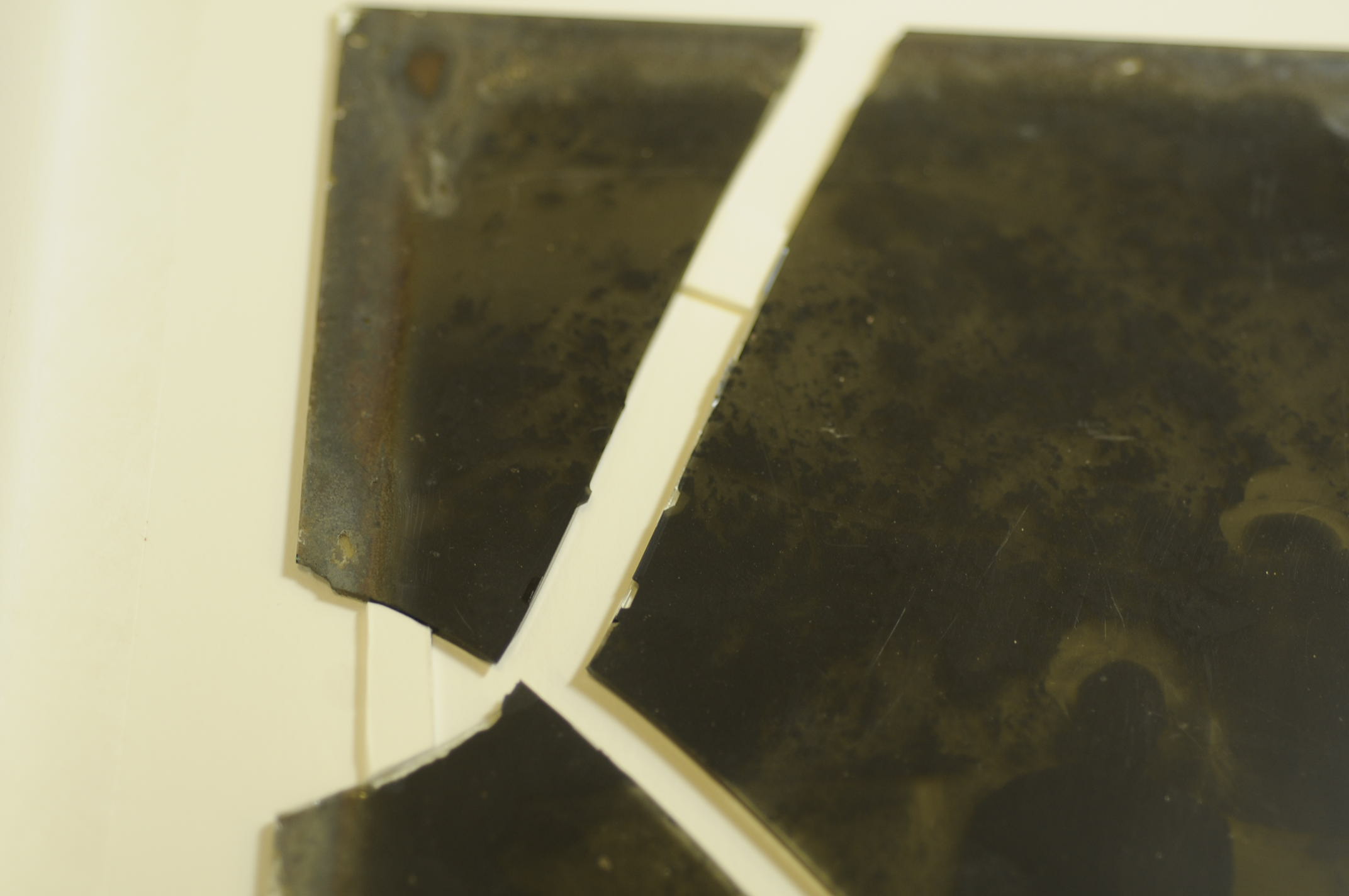
Broken glass plate negative in modified sink mat.

Broken glass plate negative in modified sink mat.

Our housing is based on a design from the National Archives.  The broken negative is stored in a covered sink mat for protection.  Small spacers separate the broken pieces to minimize abrasion.  The mat is stored flat in a box with a warning label regarding careful handling.

Detail of spacers separating broken fragments.

Detail of spacers separating broken fragments.

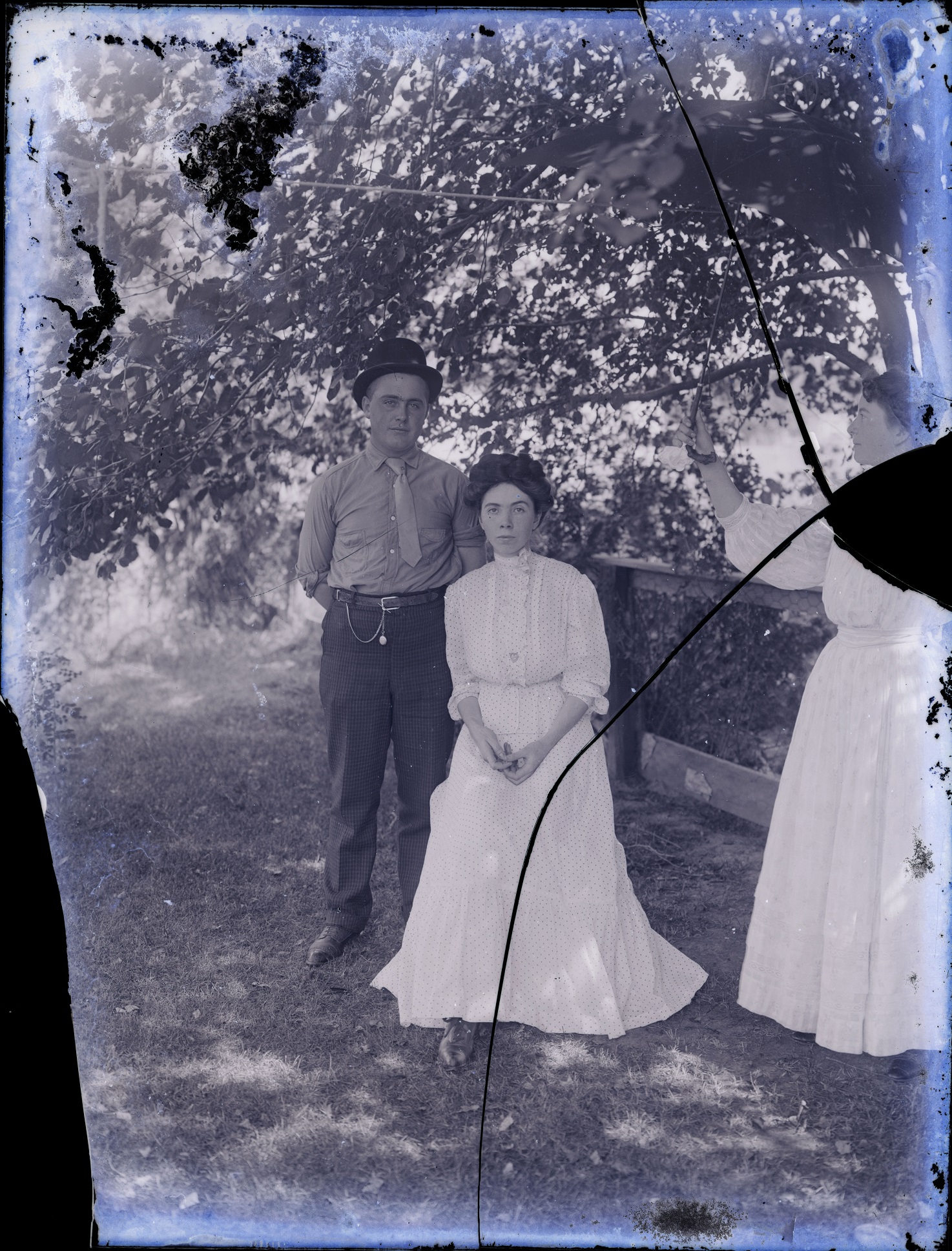
The outer mat edges are hinged, allowing the item to be removed from its housing as needed.  However, future removal should be rare, since the image was scanned before treatment.

Scanned image from glass plate negative.

Scanned image from glass plate negative.

Conservation of Texas Supreme Court Dockets

TSLAC Conservation has recently been working on a collection of 89 19th century Texas Supreme Court dockets.  These volumes document state Supreme Court proceedings and are frequently accessed by staff and patrons. The large number of items requires a blend of collections conservation and single-item treatment strategies.  Prioritizing collections issues has quickly improved access while freeing subsequent time for single-item treatment.

Texas Supreme Court dockets (foreground.) The yellow color in these photographs comes from ultraviolet filtering in collections storage.

First, a preliminary survey was conducted to characterize the oversize ledgers and classify them by severity of condition issues.  Then, collections stabilization procedures were streamlined to take place primarily within collections storage.  Once this is complete, severely damaged items will be targeted for full treatment in the conservation lab.  This workflow has enabled efficient treatment of the greatest number of items and flexible accommodation of other ongoing lab projects.

The project has presented several challenges.  The time-intensive demands of conservation documentation must be balanced with the pace of work required in a collections-level project.  This highlights the tension between product and process in an archives setting.  Further, efficiency-minded, single-item treatment techniques must be developed for oversize account books. TSLAC Conservation hopes to discuss the project’s challenges, techniques, and successes at the 2017 American Institute of Conservation annual meeting next year.

Volunteers Assist with State Supreme Court Case Files

This month, TSLAC Conservation highlights our volunteers. With their help, we are preparing 19th century State Supreme Court case files for digitization and improved researcher access.

Legal documents like the case files were typically stored in tri-folded packets and tightly sandwiched into drawers. After many years, the paper strongly retains its folds, making physical access very difficult. A series of grants from the Texas Historical Foundation has enabled TSLAC to address these documents’ physical condition and scan them for digital access.

Thick, folded packets present obstacles to researcher access.

Thick, folded packets present obstacles to researcher access.

TSLAC archivists first humidify and flatten the packets. For many case files, this is all the work that is required. Archivists then earmark any flattened case files in need of conservation treatment. That’s where our conservation volunteers come in.

Anne selects a flattened case file for conservation treatment.

Anne selects a flattened case file for conservation treatment.

Volunteers Anne and Lidia carefully separate case file packets adhered at the top with animal hide glue. They use a methyl cellulose poultice to soften the glue, release the leaves, and remove remaining adhesive. Some packets have two adhered leaves; some have 70! Anne and Lidia also mend badly damaged leaves with Japanese tissue and reversible wheat starch paste. The resulting, stabilized leaves are ready for reading room access and for scanning.

Lidia applies a methyl cellulose poultice to a previously water-damaged case file.

Lidia applies a methyl cellulose poultice to a previously water-damaged case file.

TSLAC thanks our volunteers for their hard work and dedication toward making these documents accessible!

Binding with Stubs

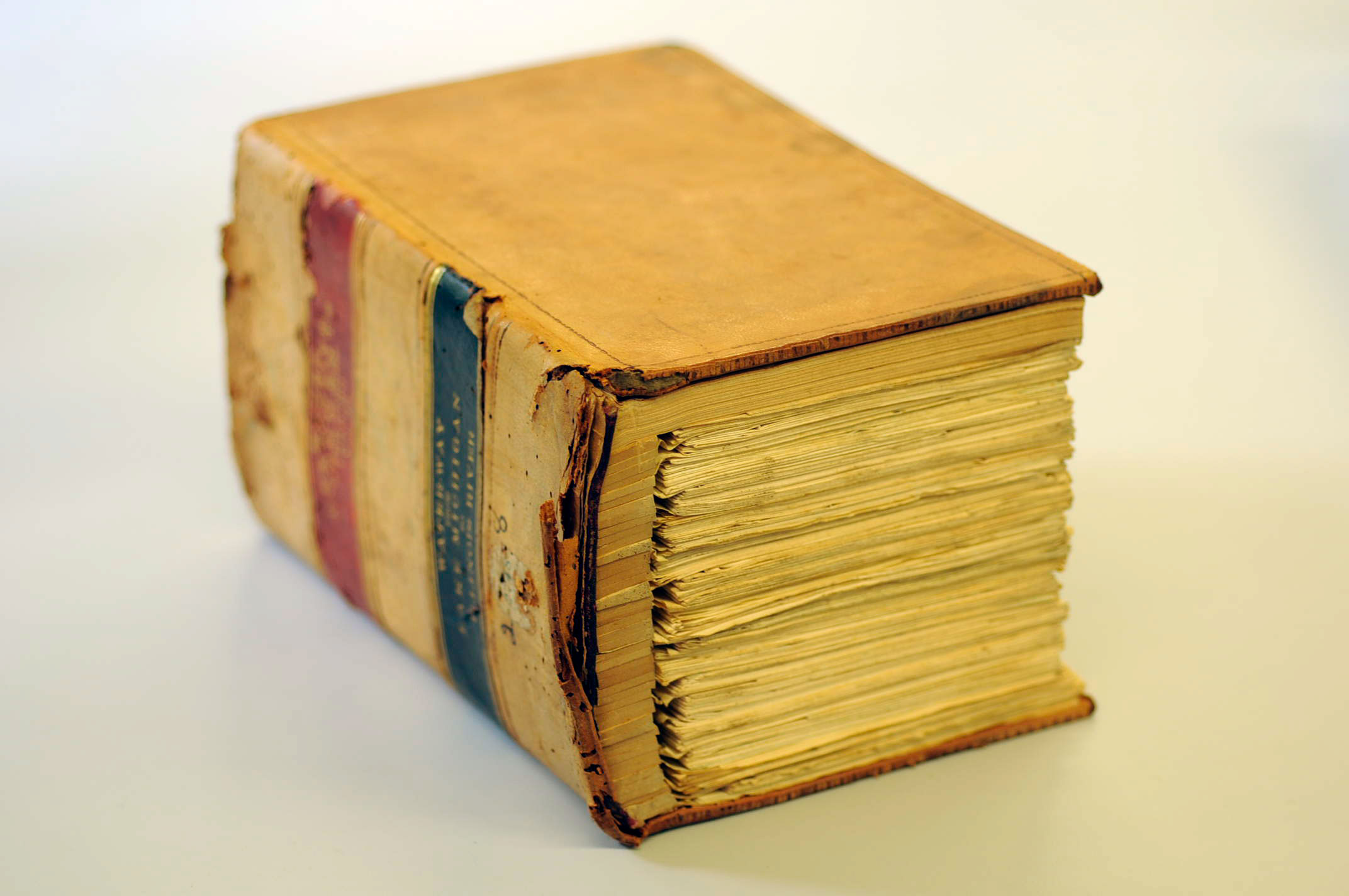
Periodically, TSLAC Conservation receives a volume for evaluation that looks something like this:

Executive Documents of the House of Representatives, First Session, 52nd Congress, 1890

Executive Documents of the House of Representatives, First Session, 52nd Congress, 1890

This book presents an example of a binding with stubs. This example is unusually large, but its design serves an important purpose. When a book contains fold-out maps, the maps attach to the binding with a single paper hinge at the spine. However, the folded map creates much more bulk than the hinge. Many bound, folded maps can create a book that is thicker on one side than the other. The resulting book is not square; in storage, uneven pressure will cause the boards to detach and the sewing to break.

To compensate for this problem, a binder can create a series of paper or board stubs between each map hinge to bulk up the spine. These stubs keep the book in square and reduce the risk of future damage. Higher-quality modern scrapbooks also feature similar bulking devices at the spine to accommodate photographs, clippings, and other ephemera.

Stubbed bindings such as the one pictured above are sometimes flagged for conservation treatment simply because of their unusual appearance. Actually, their structure is a promising indication that the binder planned ahead with the book’s longevity in mind. The book pictured above has no major structural issues, despite its size. The visible damage to the spine covering is primarily cosmetic rather than structural.

One possible conservation challenge for this type of book pertains to the maps inside rather than the binding. Repeatedly opening and re-folding these maps will cause tears over time, especially in brittle paper. In a high-use volume, a conservator might consider removing and flattening the maps for safer access. This decision would balance researcher access with the rarity, condition, and artifactual value of the binding.

Our Indian Summer in the Far West

TSLAC Conservation recently completed treatment on a fascinating travelogue, Our Indian Summer in the Far West. Published in 1880, this book chronicles the adventures of a British family on holiday in Texas and the western United States. The volume highlights two central questions in conservation treatment:

  1. How do we justify major treatment?
  2. When is it acceptable to make a major structural change?

Our Indian Summer is visually striking, with the decorative textile and gold-stamped designs typical of a publisher’s binding. It is exceptionally illustrated with 62 original albumen photographs! The original photographs, the item’s unique nature, and researcher interest justified the time required for major treatment.

The volume is illustrated throughout with original albumen photographs.

The volume is illustrated throughout with original albumen photographs.

Unfortunately, the book had serious condition problems, partly resulting from previous rebinding. Many of its pages had cracked and detached. The title page featured a poor-condition Photostat reproduction, and the endsheets were made of acidic, brown kraft paper. It was unclear how much of the book’s original structure remained as a template for the conservation treatment. Accordingly, other copies were studied at the University of Texas Briscoe Center for American History and Baylor University.
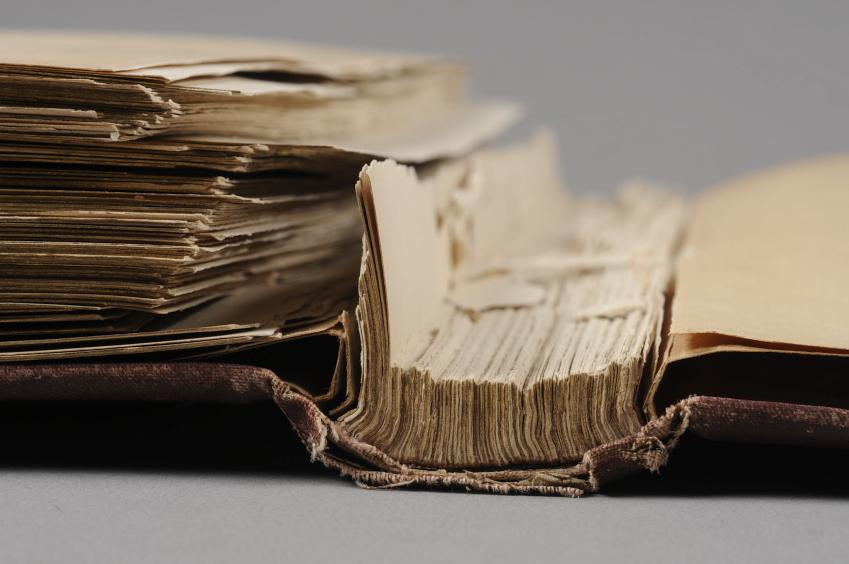
Before treatment: restrictive sewing caused pages to crack and detach.
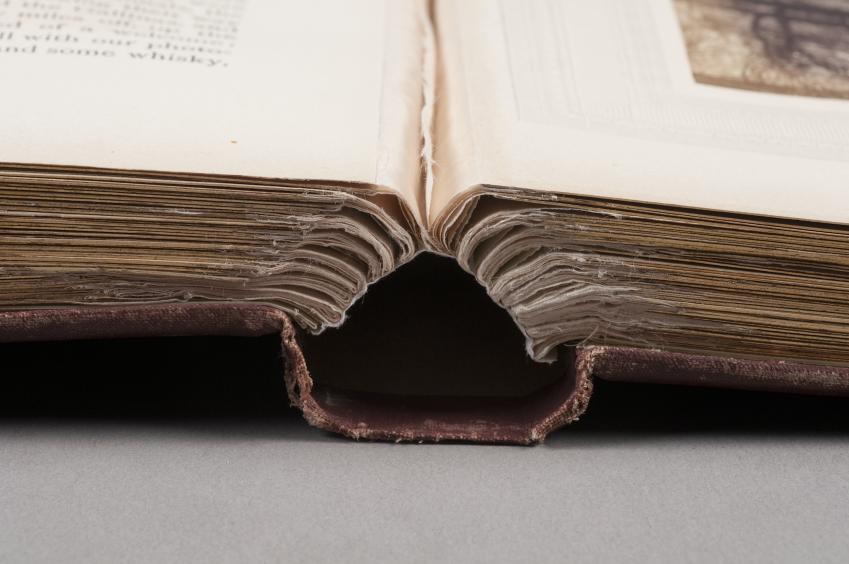
Before treatment: restrictive sewing caused pages to crack and detach.

After treatment: repaired and resewn leaves.

After treatment: repaired and resewn leaves.

From early observations, we presumed that non-original, restrictive side-sewing had caused the pages to crack and detach. However, the same sewing and cracking was observed in the comparison volumes. This indicated that the problematic sewing was likely original. The damaging nature of the original sewing justified making a major structural change: choosing a new sewing pattern.

Before treatment, remaining pages were detached and the volume was scanned for digital access. Then, every page fold in the book was reconstructed with flexible, toned Japanese tissue to allow non-destructive opening. The book was re-sewn through the reconstructed folds on three support cords. Additional steps added bulk to the sewing in order to yield a stable, square book. These steps included using thick thread (12/3), using packed sewing (with extra loops for bulk), and sewing on a thick paper support called a concertina guard.
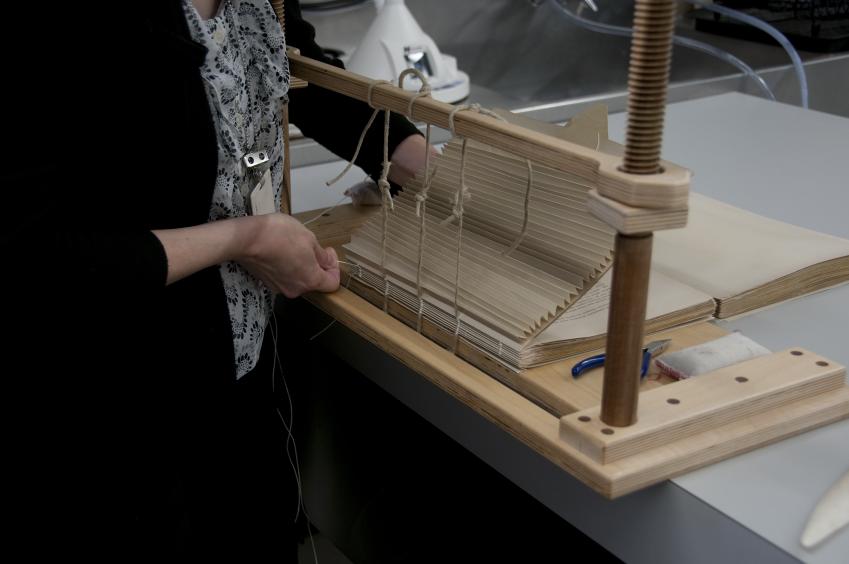
Sewing on concertina guard.

Sewing on concertina guard

The Photostat title page was replaced with a color image from the University of Texas volume, printed on dove grey endsheet paper. Toned, canary yellow endsheets, as observed in the comparison volumes, replaced the rough kraft paper. Finally, the text was returned to its original case.

After treatment, structural modification has allowed the volume to function as a book again. The original albumen photographs are secured from ongoing damage and will also be available digitally for future researchers.
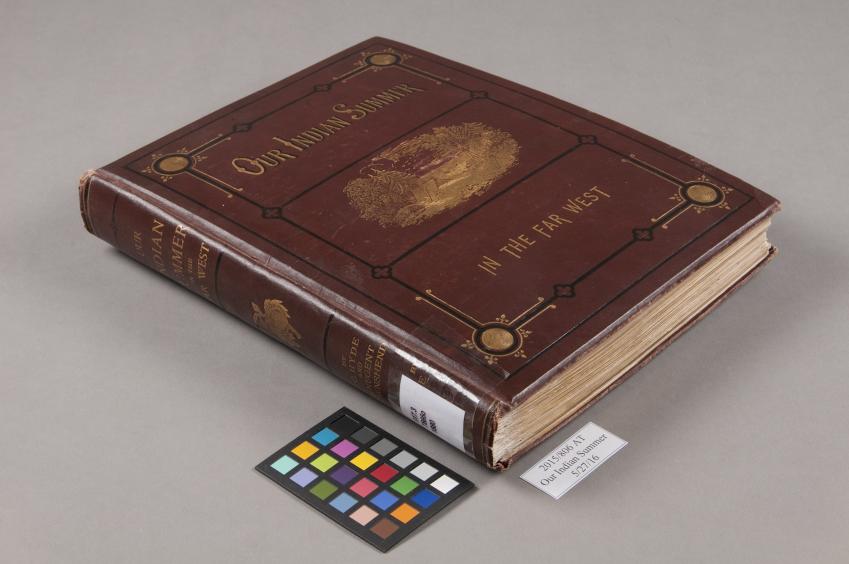
Volume after treatment.

Volume after treatment.

Thanks: Amie Oliver, Librarian/Curator of Print Materials, Texas Collection, Baylor University; Suzanne Holman, TSLAC Graphics Designer (title page reproduction.)

 

Behind the Scenes: Exhibit Preparation

TSLAC’s upcoming exhibit, Wish You Were Here, opening April 4, highlights Texas travel and tourism with a spotlight on TSLAC’s postcard and photograph collections.  Exhibit preparation takes place in the Conservation Lab. Among other tasks, exhibit preparation can involve making cradles and mounts, matting, and devising custom display devices.

This San Antonio travel brochure is being prepared for flat display in a special exhibit case with interactive drawers. The brochure is mounted to thick card with non-adhesive, archival plastic corners. In order to keep the item from sliding in the drawer, small magnets are attached to the back of the card. These magnets anchor the item to the magnetized drawer to maintain stability throughout the exhibit.

Travel brochure mounted to stiff card with archival plastic corners.

Travel brochure mounted to stiff card with archival plastic corners.

This Texas Panhandle postcard requires a custom display ramp. The ramp is constructed of acid-free, lignin-free corrugated board chosen for its light weight and strength. The display ramp is sized to accommodate a second postcard during the latter part of the exhibit in order to minimize light damage on both items. Postcards are secured to the ramp with thin strips of non-adhesive, archival plastic.

Building custom ramp for postcard.

Building custom ramp for postcard.

Postcard mounted to ramp.

Postcard mounted to ramp.

Some items require more extensive preparation work. These three postcard books are being matted for display in a large exhibit frame. The frame allows viewing from both the front and back, so the postcard books must be carefully fitted with two matching mats. Reversible hinges made of thin Japanese tissue hold the postcard books flat and vertical.

Cutting a mat template.

Cutting a mat template.

Testing fit of mat template with postcard books.

Testing fit of mat template with postcard books.

Discussing and Treating Iron Gall Ink

This summer, TSLAC Conservation participated in an informal learning series called Thinkery21. Hosted at the Thinkery (formerly the Austin Children’s Museum,) Thinkery21 invites adults to visit the museum after hours to explore a variety of science- and arts-related programming. The evening, titled “Inkery,” offered talks and demonstrations about ink and printing.

While participants made iron gall ink a few feet away, TSLAC Conservation discussed the prevalence and challenges of iron gall ink in archives. We examined photographs of famous Texas documents written with iron gall ink, including the Travis Letter and the Texas Declaration of Independence. We also tested visitors’ newly made ink with indicator paper to look for excess iron ions. These ions point to accelerated future degradation. At this point, many concerned participants asked, “But what can you do?”

This excellent question has driven significant conservation research for many years. Left untreated, iron ions from iron gall ink will break the chains of cellulose that compose paper. This causes the paper to become brown, brittle, and prone to break. In extreme cases, inked areas can completely drop out of the paper.

This treaty on Texas Comanche affairs shows advanced iron gall corrosion.  Large sections of the “G” have completely dropped out of the paper.

This treaty on Texas Comanche affairs shows advanced iron gall corrosion. Large sections of the “G” have completely dropped out of the paper.

One response increasingly used by our lab is to treat the document with calcium phytate. This treatment employs a principle called chelation. During chelation, the calcium phytate locks up the dangerous iron ions so they can’t attack the paper. This is much the same process as when a person takes antioxidants to block free radicals in his or her body. Although the iron ions are still present, they no longer threaten continuing damage to the treated document.

TSLAC Conservation was pleasantly surprised that the Thinkery21 merrymakers were so receptive to a (brief) lecture on paper chemistry! We hope the event provided a useful window onto the surprising complexities of ink on paper.

A Historical Book-like Box

The phase box is a standard conservation housing that provides physical and environmental protection. In June, TSLAC Conservation modified a phase box to approximate an original protective structure.

House Documents v.112, 58th Congress, 2nd Session, 1903-04 is a collection of soil maps published by the US Government Printing Office (GPO.) Rather than bind the maps into an atlas structure, GPO chose instead to box them as loose, folded leaves. Unique care was then taken to make the box look like a book:

House Documents v 112, 58th Congress, 2nd Session, 1903-1904

The box’s outer wrapper was covered in brown sheep leather. Spine labels are consistent with the look of GPO bindings.

House Documents v 112, 58th Congress, 2nd Session, 1903-1904

The box’s inner wrapper featured textile hinges and a printed map list.

It seems likely that this unusual structure originally protected the folded maps on its top and bottom, but these components are now missing. The back, covered board is missing, as well.

These maps receive relatively light patron use, so it was acceptable to leave them folded and boxed rather than flattened in a folder. Though the quickest treatment would be simply creating a new box, a bit of extra planning and time allowed preservation of the original housing’s careful aesthetic design.

First, a new inner wrapper was constructed of lightweight cardstock. The list of maps was lifted from the original inner wrapper and adhered in the same position in the new structure. Then, an outer phase box was constructed and the covering boards adhered. A new back board was made and covered in toned Japanese tissue.

House Documents v 112, 58th Congress, 2nd Session, 1903-1904

Existing and new boards are adhered to the flattened phase box. Here, the replacement board has not yet been toned to match the leather.

The result is a more robustly protective structure that retains the look and labeling of the original. This box better protects the maps inside and retains its unusual, carefully-designed appearance.

House Documents v 112, 58th Congress, 2nd Session, 1903-1904

New phase box with covering boards.

Conservation Treatment of an Oversize Ledger Binding with Canvas Cover

Canvas covers protect many oversize ledger bindings in TSLAC’s collection. Like modern paper covers for children’s textbooks, canvas covers were meant to safeguard government records through years of heavy use. Unlike modern paper covers, canvas covers are original to their bindings. They feature leather corners and decorative paper doublures (seen when the book opens) that match the volume.

General Index to Court of Criminal Appeals, 1919-1947 (19 3/4” x 16” x 4”) with damaged canvas cover.

General Index to Court of Criminal Appeals, 1919-1947 (19 3/4” x 16” x 4”) with damaged canvas cover.

Inside the book, the canvas cover is backed with stiff card. Leather corners, decorative paper, and manufacturer’s labels on the cover match the original binding.

Inside the book, the canvas cover is backed with stiff card. Leather corners, decorative paper, and manufacturer’s labels on the cover match the original binding.

Today, tattered canvas covers present a conservation conundrum. Is the cover simply a disposable protective layer at the end of its useful life? Or is it an inherent part of the binding that should be preserved? Given the abundance of government ledger bindings, can full treatment be justified and time-efficient?

These questions shaped treatment of the General Index to Court of Criminal Appeals, 1919-1947. Frequent use of this 40 lb+ book had left its canvas cover frayed and torn, with large losses at its edges and all along its spine. An ideal treatment would preserve legibility of labeling on the canvas cover and the exposed book’s spine for the use of reading room staff.

A treatment was designed to retain and stabilize the canvas cover. First, losses were filled with toned muslin. In order to achieve reversibility and prevent adhesive strike-through, heat-set tissue was applied beneath the torn edges of the canvas. Shaped, toned muslin patches were then adhered with PVA to bridge canvas losses.

Inserting toned muslin fills beneath canvas backed with heat-set tissue.

IInserting toned muslin fills beneath canvas backed with heat-set tissue.

Repairs to the spine leather were completed with linen-backed toned tissue. Then, the remaining segments of canvas cover were secured to the binding using a modified reback treatment. A reback is a common spine repair method in circulating collections. Since our canvas spine cover was missing, the remaining canvas cover was rebacked to the book’s original spine covering. This involved lifting material in the book’s hinges, adhering the loose canvas on the board’s inner edge with reversible Lascaux, and reattaching the original covering material.

Preparing hinge region to “reback” the remaining canvas cover to the book’s exposed spine covering.

Preparing hinge region to “reback” the remaining canvas cover to the book’s exposed spine covering.

In creating a hybrid structure of canvas cover and original binding, this treatment acknowledges both elements as integral parts of the volume. The treatment is aesthetically tidy, stabilizes the volume for ongoing use, and remains reversible with heat and solvent. The treatment required approximately 10 hours to complete, which is not unrealistic for other, prioritized volumes with similar condition issues.

Future versions of this treatment might revisit the use of heat-set tissue, which may prove to be somewhat too reversible in this application. In place of heat-set, inconspicuous sewing could improve durability while maintaining reversibility and aesthetic compatibility. However, sewing would be complicated by the inability to turn the cover inside out. TSLAC Conservation welcomes thoughts and discussion about this treatment.

Before treatment

Before treatment

After treatment

Before treatment

Before treatment

After treatment

May Day! May Day!

Each year, the preservation community observes MayDay on May 1 to promote disaster preparedness and recovery. Along with Preservation Week (April 26 – May 2) and Preservation Month throughout May, MayDay is a great time to ensure that your family heirlooms are protected against harm.

Water is among the greatest threats to books, documents, and photographs. Water can cause permanent staining, fading, and warping. It also increases other risks, like mold and pest infestation. Here in Texas, hurricanes and thunderstorms make flooding a very real concern.

How can you guard your keepsakes from flood damage? One simple step is to store items off the floor. The majority of floods leave just a few inches of water behind. Storing materials in elevated cabinets or shelves keeps them out of harm’s way. If your storage furniture is flush to the ground, consider elevating it with bricks, cinder blocks, or other materials. Just a few inches of clearance can turn a potential disaster into a quick cleanup.

Preservation Week 2015

For more on this and other Preservation Week tips, visit TSLAC’s Facebook page. Happy MayDay!