The Sam Houston Center Quarterly Book Club volunteered for hundreds of hours to sort and ship the books to troops, veterans and their families.
Inspired by the wartime spirit of service celebrated in Addison Armstrong’s book War Librarian, members of the Sam Houston Center’s Quarterly Book Club collected more than 560 gently-used books and shipped them to active-duty service members, veterans, and their families.
The Sam Houston Regional Library and Research Center is a component of the Texas State Library and Archives Commission’s (TSLAC) Archives and Information Services Division (ARIS). It is located in Liberty, Texas, 41 miles northeast of Houston. The project originated in the summer of 2025, when the center’s book club read War Librarian, about World War I efforts to raise funds and collect books for camp libraries, military hospitals, and similar locations.
Club members were inspired to organize a similar effort, so Sam Houston Center staff reached out to Operation Paperback, a national, non-profit organization that connects volunteers with American troops, veterans, and families, to inquire about the feasibility of a community book drive benefitting the users of Operation Paperback.
Once a plan was in place, the book club launched its drive in early 2026 as a Texas America250 initiative and collected donations through July 4, 2026. Local media promoted the book drive, and the community responded generously.
Volunteers and staff shipped 565 books to troops, veterans, and their families! Packages with up to 20 books went to 21 states, including Washington, DC, and various locations overseas. Soldiers deployed in Okinawa, Japan and unidentified locations in Europe, Africa, Canada, and/or the Middle East received books from Southeast Texas readers.
A volunteer sorts donated books to mail to American soldiers.
Book club members met three times to process books for shipment. Volunteers sorted every book according to a detailed list of fiction and non-fiction genres, after which a list of individuals in need of books was requested from Operation Paperback. With a name, address, and lists of preferred genres in hand, book club members went “shopping” for each person among the piles of books, filling a box with reading material that would be most enjoyed. Books were shipped with Texas America250 and Texas Digital Archive bookmarks created by TSLAC.
Once packed, a box had to be taped, labeled, and a customs form completed if it was being shipped overseas before it could be loaded and carried to the local post office by SHC staff. Forty-five packages, some weighing 15-20 pounds, were shipped over a two-week period, with the help of workers at the Liberty, Texas post office who graciously supported the book club’s effort to honor America’s military. Books for all ages, including a vast array of genres ranging from poetry to biography and classic literature to fantasy, were mailed.
“Our book club and staff were so pleased to be able to gather books for American soldiers and veterans,” said Alana Inman, Manager of the Sam Houston Center. “I am proud of how hard everyone worked and the community’s generous book donations.”
Hours: Sunday, closed; Monday and Tuesday, 12:00 noon to 8:00 p.m.; Wednesday, Thursday, Friday and Saturday, 10:00 a.m. to 6:00 p.m.
Learn more:Watch our short video for an in-depth look at San Antonio Central Library
What makes this library special:
Known popularly as the “Enchilada Library” because of its signature color, this gorgeous building, designed by renowned Mexican architect Ricardo Legorreta, opened to the public in 1995. A contest run by the San Antonio Express-News asked readers to suggest a name for the vivid color, and “Enchilada Red” won.
Immediately upon entering the library, visitors are drawn to the Art Walk, an art gallery on the first floor. The striking pieces here include Caballo Tamaño Grande, a bronze sculpture of a horse by famed Colombian artist Fernando Botero; and Mi Vida, a 36-foot mural by artist Jesse Treviño depicting movie marquees and a memorial altar. The San Antonio Central Library is a must-see for San Antonio residents and visitors.
Don’t miss: The Fiesta Tower sculpture by Dale Chihuly
This breathtaking, two-story multicolored glass sculpture at the center of the library was created by famed artist Dale Chihuly, in commemoration of the library’s centennial in 2003.
“The sculpture weighs 4,500 pounds. And only 1,000 pounds of that is the infrastructure to hold it up. So the rest is glass. There are 3,500 pounds of glass, 917 individual hand-blown glass pieces. And each piece is about three feet high… Everyone has to come and see this in person,” said Krystal Jones, Director of the San Antonio Department of Arts and Culture.
“People can look at this piece and see many different things, which is what art is all about. Many people see animals, or sea creatures. I particularly think of flowers and also the South Texas birds when I look at the piece,” Jones said.
The sculpture is visible from each of the library’s six floors.
“You can see it from so many so many different levels, so many different floors, you get different perspectives. And of course, that’s what the library does, is bring different perspectives,” Jones said.
Flagship library for a large system
The San Antonio Public Library System comprises 30 locations, including the Central Library, the Kampmann Library Portal at the Briscoe Western Art Museum, and a library partnership with Roosevelt High School. The system delivers library services to approximately 1.9 million residents in San Antonio and Bexar County.
Library Director Sukrit Goswami has been leading the system since 2025. He follows longtime library director Ramiro Salazar, who retired.
“When this opportunity came to lead one of the largest library systems in the country… I was intrigued, not just about the size, but I was intrigued about how beautiful the city is, and how much potential the city has and how much work we can do as library leaders to make a difference in this wonderful community,” Goswami said.
Latino Collection and Resource Center
The Latino Collection and Resource Center (LCRC), located on the first floor of the San Antonio Central Library, is a cultural and educational resource which chronicles and celebrates the literature, heritage, and contemporary life of Latinos in the United States.
It was founded by the Chicano arts historian and scholar, Dr. Tomás Ybarra-Frausto, who donated many items from his vast personal collection to the library in 1996. Then the SAPL collection development team began purchasing items to broaden the collection, which now includes more than 14,000 items.
The Latino Collection “is hybrid in nature, both contemporary and scholarly,” said Sarah De La Rosa, Program Manager of the LCRC. The materials, in Spanish and English, range from children’s books to young adult and adult fiction, nonfiction, and biographies.
In addition, the LCRC hosts many programs including ESL study club, summer salsa dance classes, poetry events, and platicas (author conversations).
Earlier this year, the library hosted author Tara López discussing her award-winning book Chuco Punk: Sonic Insurgency in El Paso, which chronicles the history of El Paso punk rock. Following the author’s talk, the library hosted a live punk show on top of the Central Library’s parking garage. About 100 people attended the author talk; the punk show drew more than 900.
“We do everything from music, dance performances, to poetry readings and rotating art exhibits. We host film screenings,” said De La Rosa. “The programming is meant to highlight the collection and bring people to the collection.”
Hollywood appearances
The San Antonio Central Library is featured in two movies. In Selena, the 1997 film starring Jennifer Lopez, the building is featured in this scene where Selena is supposed to be in Mexico City. It also serves as the “OSS Junior Headquarters” (kid spy headquarters) in the Robert Rodriguez 2002 movie Spy Kids 2: The Island of Lost Dreams.
What to look for as a first-time visitor: The Art Walk and the Latino Collection on the first floor. The Chihuly sculpture in the main atrium. The always-busy children’s section on the third floor. The Teen section, also on the third floor, which draws crowds on weekdays after school. The Texana/Genealogy Department and Texana Resource Center (currently available on the first floor but soon to reopen with a new, remodeled area on the sixth floor.) “Of course, enjoy our Art Walk, enjoy our exhibits. And make sure to visit every single floor. On every floor, magical things are happening,” Goswami said. Pro tip: Don’t miss The Book Cellar, the used bookstore in the basement of the Central Library; all proceeds benefit the library.
And one more thing: A short drive away from the Central Library is the lovely Landa Branch Library (located at 233 Bushnell, San Antonio), located inside a beautiful historic home in the Monte Vista Historical District. It’s part of the San Antonio Public Library System.
“Harry Landa donated the mansion, which used to be his and his wife’s residence, to the library in memory of his wife, Hannah,” Goswami said. Landa wanted the mansion to become a library, and the adjacent lands to become a playground; he gave both to the City of San Antonio in 1946. It’s worth a visit to see the carved marble mantle, crystal chandelier, and elegant staircase, as well as the gracious gardens, shady playground, and picnic area outside.
Opening doors to art and literature
The annual San Antonio Book Festival is a free, one-day celebration of books and literature that takes place every spring, drawing about 25,000 attendees each year. It’s produced by the San Antonio Book Festival, an independent nonprofit organization.
“The Central Library is really the home base for the San Antonio Book Festival. It’s one of our busiest days of the year,” said Scott Williams, Marketing Manager for San Antonio Public Library. “Every single floor is full of people that day. Of course, mostly what people will come here for is to attend author sessions…but we also have activities for kids, and we take advantage of the huge crowd the book festival draws to make sure that we are also introducing the community to everything that their library offers.”
Above, chef Adán Medrano, author of the Texas Mexican Plant-Based Cookbook, poses with fans at the San Antonio Book Festival in April 2026.
“The San Antonio Public Library means a lot to me,” Jones said. “And it means a lot to our community. The library that I grew up in, I mean, it was just books, but the San Antonio Public Library…it’s books, it’s music, it’s technology. It’s events, and of course, it’s art. It is truly opening a world of possibilities to all ages to let people know that all of this information and art is for you. And it’s free.”
Above, teens gather in the San Antonio Central Library’s dedicated teen area on the third floor.
Above, students at Magnolia ISD learn about Texas history from the Texas America250 traveling exhibit at their school.
Across Texas, thousands of Texans of all ages are participating in the Texas America250 Reading Challenge, and thousands more have viewed the Texas America250 traveling exhibit at their local library, school, or museum. Check out this Facebook album of many of the participants!
Texans are invited to log 2,500 minutes (41.6 hours) of reading, state parks visits, and/or service activity before December 31, 2026. Upon completion of the Reading Challenge, participants are eligible to receive a special certificate from their public or school librarian.
As of July 8, 2026, 316 libraries from all over Texas have registered to be part of the Reading Challenge.
The numbers continue to be impressive: as of the end of June, there have been 5,400 individual downloads of the “Mosey Along the Reading Trail” reading log map, which participants can use to track their progress, and more than 4,100 downloads of the Reading Challenge FAQ. Both the reading trail map and the FAQ are available in English and Spanish.
There’s still time to join! Download a reading log map and FAQ to get started!
Many schools and libraries are offering incentives and prizes for readers who complete the challenge. In Ponder ISD in Denton County, for example, students are entered in a drawing to win one of two grand prizes and can win other awards as well.
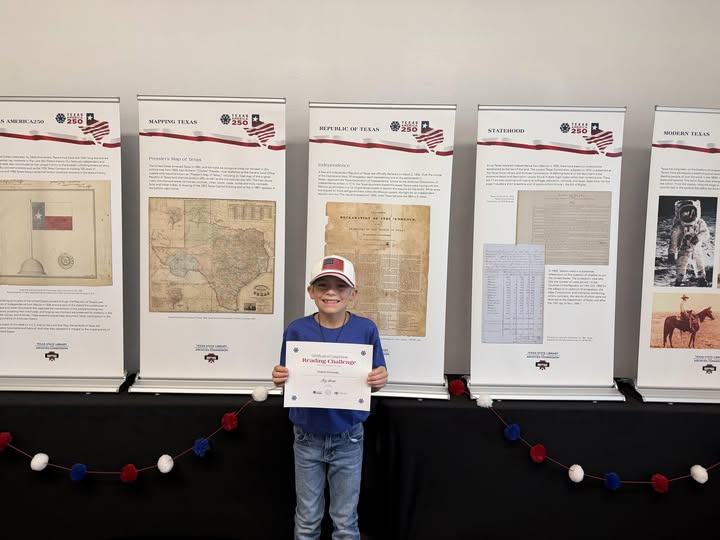
A young patron at Archer Public Library proudly displays his Reading Challenge completion certificate.
Texas America250 Traveling Exhibit
Seven hundred sets of the Texas America250 traveling exhibit, highlighting some of TSLAC’s Texas treasures, have been shipped or hand-delivered to public libraries, schools, small museums, and other community organizations over the past year.
Many communities combined the exhibit display with local programming, with events and speakers teaching students and library patrons about Texas history.
The exhibits were warmly received by the exhibiting organizations (deliveries began in fall 2025 and continued through spring 2026. All exhibits have now been distributed.)
“I opened it tonight. They are beautiful!!!” wrote Linda Coker of the Hays County Historical Association.
“We look forward to displaying this exhibit proudly,” wrote Angie Anderson of the Harlingen Arts and Heritage Museum.
TSLAC offers many downloadable and printable posters, bookmarks, and other material supporting the exhibits. We’ve had a grand total of more than 40,000 downloads of these self-print materials!
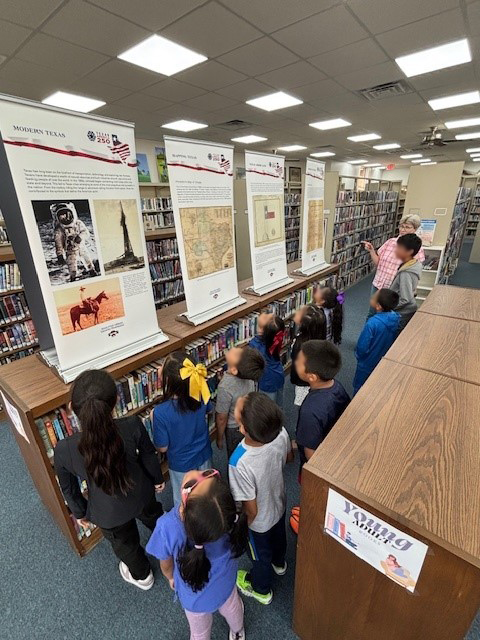
Students at Palacios Library study the panels in the traveling exhibit.
Media Mentions
The Texas America250 exhibits and reading challenge have been mentioned in media articles more than 225 times; have been mentioned on social media more than 250 times; and have been featured on TV news stations around the state. Watch the KLBK piece from Lubbock.
Special thanks to The Summerlee Foundation, the Texas Library and Archives Foundation, and the Institute of Museum and Library Services for their support of our Texas America250 programming.
Author John Erickson has devoted his writing life to sharing the joys and challenges of life on a ranch in the West Texas Panhandle with generations of readers.
The author of the beloved and wildly successful Hank the Cowdog series—84 books, which have sold more than 10 million copies—sets his children’s books in the ranch setting he knows like the back of his hand. Erickson, who worked as a cowboy for many years, and his wife Kris live on a ranch near Perryton.
“I think I’ve done a pretty good job of describing my little piece of Texas and the universe,” he said, “and it contains a lot of funny and interesting characters.”
The Texas Center for the Book has chosen Hank the Cowdog #83: The Case of the Poison Toad by Erickson as the 2026 Texas Great Read Youth Selection. Small Town Author, also by Erickson, is the 2026 Texas Great Read Adult Selection.
Small Town Author, published by Texas Tech University Press, is Erickson’s autobiography and shares his journey from the small town to the big city and back again. Hank the Cowdog: The Case of the Poison Toad, published by Maverick Books and illustrated by Nicolette G. Earley, continues Hank’s adventures with his sidekick Drover.
This marks the first time the Texas Center for the Book has selected Adult and Youth Great Reads by the same author. We are proud to announce our titles for 2026 and to celebrate Erickson and his many years of creating books for children that are deeply rooted in the ranching heritage of Texas.
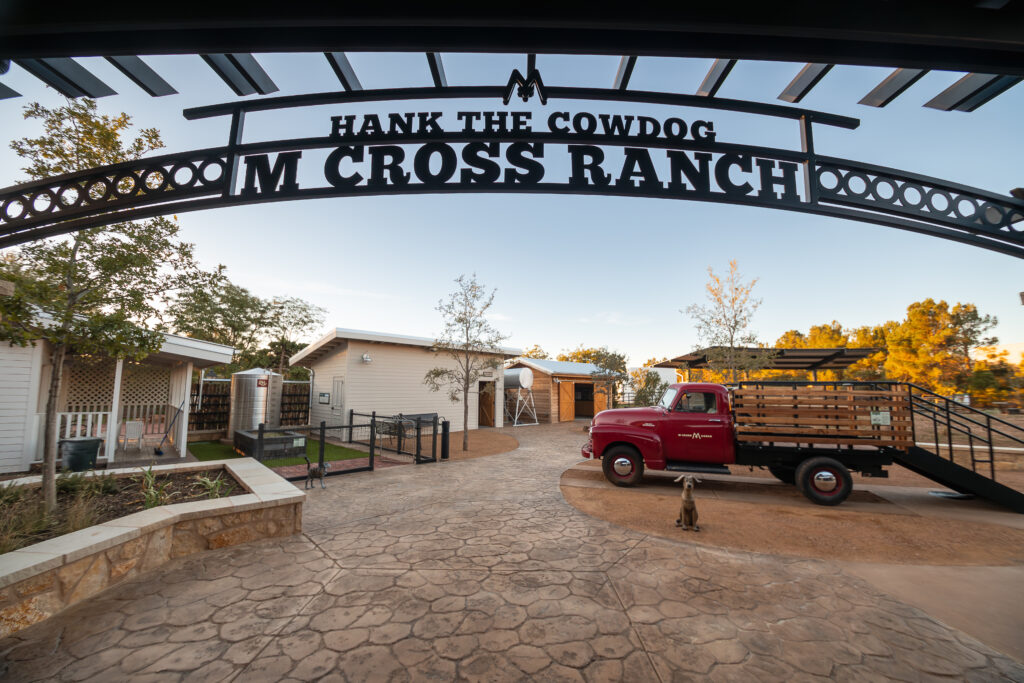
Hank the Cowdog at the National Ranching Heritage Center
When it came time for the National Ranching Heritage Center, a museum and historical park at Texas Tech University in Lubbock, to find a way to teach kids about ranching life, Hank the Cowdog was a natural fit.
“There’s a real authenticity to Hank,” said Julie Hodges, the Helen DeVitt Jones Endowed Director of Education at the Center. “John Erickson wrote about the ranch experience based on his real experience. He really was a cowboy, and he lives on a ranch to this day. And kids, I think, can see that truthfulness. The books are funny, but they also have heart, courage, friendship, and responsibility woven through them.”
The National Ranching Heritage Center at Texas Tech is dedicated to preserving and interpreting the history of ranching in North America, Hodges explained. “We have more than 50 authentic ranching structures that were relocated to our site and reconstructed so that visitors can literally walk through history from the 1700s forward. But we’re also focused on the future. Our mission is also about helping people understand modern ranching, stewardship of the land, food systems, natural resources, and the people who depend on the land for their livelihoods today.”
Like many Texans, Hodges grew up reading the Hank the Cowdog books, read them to her own children, and now reads them to her grandson. She reached out to Erickson in 2014, and a wonderful partnership was born. At his first book reading at the Center, more than a thousand people came.
Learning about ranching
One of the results of this partnership is an educational book series. The Ranch Life Learning Series consists of five books, written by Erickson and starring Hank the Cowdog, that teach students about ranch life. Titles include Ranching and Livestock, Cowboys and Horses, Ranch Weather, and more. The books are available through the Ranching Heritage website, through Amazon, or the hankthecowdog.com website.
The Center has developed educational materials paired with each book. All are free to download and popular with elementary school libraries around the country.
Visit the Ranch Life Learning Center in Lubbock
If you’re able to get to West Texas in person, at the Cash Family Ranch Life Learning Center (part of the National Ranching Heritage Center) you can explore what life on a ranch is like, with Hank the Cowdog as your guide!
“Hank the Cowdog has this loyal following and trustworthiness with parents and teachers and librarians everywhere. So having him in our museum is just another way to welcome folks in and give them an opportunity to learn about ranching in a way that is very natural,” Hodges said.
Hours: Monday, closed; Tuesday and Thursday, 9:00 a.m. to 8:00 p.m.; Wednesday and Friday, 9:00 a.m. to 5:00 p.m.; Saturday and Sunday, 9:00 a.m. to 4:00 p.m.
Learn more: Watch our video for an in-depth look at the J. Erik Jonsson Central Library
The Dallas Public Library’s copy of the Declaration of Independence is the only one located west of the Mississippi.
What makes this library special:
The seventh floor of the massive J. Erik Jonsson Central Library holds two rare treasures, both free to view by the public. The first is an original copy of the Declaration of Independence printed on the night of July 4, 1776, one of only about 25 surviving copies. It’s the only original copy located west of the Mississippi.
“When the Declaration of Independence was ratified, they had the one document that everyone signed and we all know about that one, it’s at the National Archives,” said Manya Shorr, Director of the Dallas Public Library (DPL). “But they had to figure out how to tell everyone in the colonies that we were now a nation. So they printed between 80 and 100 copies, unsigned, and they sent them out to the colonies. And the copy we have is one of the original broadsides.”
The copy at the DPL is known as the “lost copy” and is one of only a few remaining in good condition.
“It was found in a bookstore in Philadelphia in 1968, folded up in a box,” Shorr said. “It was sold at auction in 1969 for $404,000 to two Dallas businessmen. In celebration of the Bicentennial in 1976 they sent it around the whole country, and it came back here and was given to the City of Dallas.” At first displayed at the Dallas City Hall, the Declaration found its permanent home when the J. Erik Jonsson Central Library opened in 1982.
Nearby, on the same floor, is an even older and equally beloved treasure—an original copy of Shakespeare’s First Folio, published in 1623. Shakespeare died in 1616 without publishing any of his plays. Two of his friends decided to publish 36 of his plays in this volume. Only about 235 copies exist today, and the DPL is privileged to have one of them.
“Of the 36 plays that are in the Folio that we have, 18 of them had never been published before,” Shorr said, including The Tempest, Macbeth, and Twelfth Night. The book was donated to the library in 1986 by the Dallas Shakespeare Club.
“People absolutely come from all over the world to see what we have—specifically what we have on this floor,” Shorr said. “To have an America’s founding document, especially in our country’s 250th anniversary birthday year—I’m beyond thrilled.”
About half a million people each year visit the Dallas Public Library’s downtown location.
On the eighth floor of the Central Library, the Lloyd DeWitt Bockstruck Genealogy Collection holds one of the largest and most comprehensive collections for family history research in the United States.
“The collection is worldwide,” said Stephanie Bennett, Genealogy and History Manager at DPL. “The Center was established so that no matter when you come to Dallas, we have something available for you to look at to learn more about your own family history. Whether that’s a social period in history, a book with your family’s name in it, a record you haven’t seen before, we want to make sure you leave with something you didn’t know.”
Suzan Younger is a former president of the Dallas Genealogical Society who has been doing research in DPL’s Genealogy Collection since the 1970s.
“The collection is so large and so good,” Younger said. “They have all the census records, there are always new books coming out and new technology. The library is an affiliate of the Family Search Network. The tip I have—first come and talk to the staff. Whether you are a beginner or experienced genealogist, the staff knows their collection.”
The Heritage Lab, also on the eighth floor, is an invaluable space for patrons.
“The Heritage Lab is for preserving your family history,” Bennett said. “Whether that is a scrapbook that you want to scan or a family Bible you are scared to open because it’s so fragile, we can help you. We also convert VHS tapes, records, mini cassette tapes—you can use the equipment and scan it for free.” Preserving the voices of late loved ones is meaningful to many people: “They’re an important part of your family history, and we want you to be able to preserve that for future generations.”
Many newspapers, magazines and thousands of mourning cards are part of the library’s JFK collection.
The President John F. Kennedy Assassination Collection: “The JFK Collection is one of our major collections. We’re obviously in Dallas, where the assassination occurred. Librarians at the time really worked hard to collect everything they could to record information. I would say our collection is second only to the Sixth Floor Museum, also located in Dallas (nearby), so we are a major hub for people coming to do research,” said Misty Maberry, History and Archives Manager for DPL.
“One of the most unique things that we have is our mourning card collection: cards and mementos and photos left at Dealey Plaza. Thousands of people came to Dallas from all over the world to pay tribute to President Kennedy.”
Filmmaker Oliver Stone did research at the library for his film JFK; author Stephen King had his assistants come to the library for research for his book 11/22/63. DPL librarians have also worked with documentary filmmaker Ken Burns’ team.
In addition to the JFK Collection, Maberry’s division oversees a photography collection with more than one million images (both print and digital images) and worked with the Portal to Texas History at the University of North Texas to digitize records from The Dallas Express, the largest Black newspaper in the South during its publication era (1892-1970).
What to look for as a first-time visitor: The Declaration of Independence and Shakespeare First Folio on the seventh floor. The Genealogy Collection and Heritage Lab on the eighth floor. And so much more—the library’s Creative Spaces include the third floor Story Center, where you can record a podcast or film a movie. The fourth floor Fiber Arts Workroom is a favorite for patrons who enjoy sewing, knitting, embroidery, and weaving. There’s also a Pollinator Garden on the fifth floor balcony facing City Hall. The Central Library features extensive public art, including a sculpture by Barbara Hepworth and a serigraph by Texas-native Robert Rauschenberg. The JFK Collection is on the seventh floor.
And one more thing: DPL is celebrating its 125th birthday in 2026. In addition to the Central Library, DPL has 28 branch locations throughout the city of Dallas.
“We are proud to serve the citizens of Dallas,” Shorr said. “Everything we do is for them. I really hope people take the opportunity to come visit us, because we are here for them.”
By Michele Chan Santos, Coordinator, Texas Center for the Book
Above, Meiling Lung Newman, the granddaughter of Joe Lung, one of the first Chinese Americans to live in Austin, adds her family photos to the Roots Unveiled exhibit.
Roots Unveiled is an innovative, multidisciplinary exhibition which explores the history of Chinese Americans in Texas through art, video, photographs, and artifacts. First displayed at the Austin Public Library downtown in the summer of 2025, the exhibition is scheduled for the Julia Ideson Building at the Houston Public Library in 2027, and organizers are currently working on scheduling displays for 2026.
Developed in partnership with the Austin History Center and the Austin Public Library, the exhibition traces the intertwined histories of China and the United States. It brings together new works by contemporary artists, including Gary Card, Philip Cheung, Li Wei, June Xu, Jing Yang, Lok Yiu, Xuhua Zhan, Michael Wei, Long Yunna, and Kong Ka Ying, alongside archival materials.
Artist June Xu is the driving force behind the Roots Unveiled exhibit.
June Xu is the founder and president of the Asian American Art and Culture Initiative (AAACI), which created the exhibit. The AAACI, headquartered in Houston, was founded to preserve Asian American stories and to empower future generations, Xu said.
“The AAACI exists to break down barriers, challenge misconceptions, and create a vibrant platform where art, history, and community action intersect,” she said. “Through exhibitions, oral histories, youth programs, and collaborative projects, we preserve stories that risk being lost to time and inspire young people to carry them forward.”
In the Roots Unveiled exhibit, artists explored topics including the nearly 20,000 Chinese railroad workers who built the Transcontinental Railroad and the discriminatory Chinese Exclusion Act of 1882 and its repeal in the 1940s.
On a more personal note, the exhibit explored the story of Chinese railroad worker Joe Lung, who settled in Austin in the late nineteenth century and was one of the first Chinese Americans in Austin; and his daughter Inez Lung, the first Chinese female student at the University of Texas at Austin. Inez Lung returned to China in the 1920s, teaching at a middle school there for many years.
Artist Lok Yiu travelled to Kaiping, China, to locate Long Hui Lou, the watchtower Joe Lung commissioned in 1917 with remittances from Texas—a building he never returned to see. Working with curator Xuhua Zhan and drawing on a 1929 photograph from Inez Lung’s biography, they not only traced the tower’s exact location but also helped reconnect Lung family members in China and the U.S. who had lost contact.
Joe Lung’s grandchildren helped with the exhibit, sharing family photos for a photo gallery called Cousins (part of Roots Unveiled) that brought together images of the Lung family spanning more than a century.
“We had no idea that we would discover such a rich history just within this family,” Xu said. She was surprised and delighted to find out that she is a distant relative of the Lung family, as their village in China is next to her grandparents’ village.
The painting “Dining,” by June Xu, is featured in Roots Unveiled and shows a multicultural community gathering.
“As the exhibition travels, each city will become a new site for research and collaboration,” Xu said, “uncovering local Chinese American histories and inviting communities to co-create content.” She envisions Roots Unveiled as not just a touring exhibition but as a chance to engage museums, artists, and Asian American communities in conversation about identity, memory, and cultural belonging.
If your library or museum is interested in hosting the exhibit, you can contact June Xu at june@aaartculture.org. For more information about the exhibit, go to www.aaartculture.org or follow them on Instagram at @aaartculture.
— By Michele Chan Santos, Coordinator, Texas Center for the Book
Above, families and children enjoy storytime with Batman at BookSpring Fest 2025.
This month, the Texas Center for the Book is honored to have Emily Ball Cicchini, Executive Director of BookSpring, talk with us about her wonderful organization, which focuses on building literacy skills for children. Emily is also an author and playwright, so we’ll be discussing that, too! Thank you for joining us, Emily!
Emily Ball Cicchini, Executive Director of BookSpring
Q: For our readers, please tell us about what BookSpring is and what it does.
A: BookSpring is a nonprofit based in Austin, Texas, dedicated to building early literacy and book ownership for children and families. For more than 50 years, we’ve worked to increase access to books and reading, because research shows that children who grow up with books at home are more likely to succeed in school and in life. We distribute about 250,000 books to 100,000 children from birth to age 12 each year.
Q: The audience for our blog is public and school librarians in Texas. What programs does BookSpring have that you’d like to share with them? How do they apply?
A: Our Books Beginning at Birth program is available to families across the state. It’s a program that provides young children and their families access to books and resources to support the development of early literacy skills and help them foster a love of reading. You can learn more at b3tx.org. All families can access an open library of hundreds of digital children’s books. Once enrolled, children may receive free print books delivered to their home twice a year until they turn five. (Supplies are limited and preference is given to children living in Texas Opportunity Zones.) Learn more and apply here.
In addition, in Central Texas (Travis, Williamson, and surrounding counties) we offer two in-person programs designed to reach children from birth through age 12:
Books for Me (ages 3–12): Provides “forever books” that children choose and take home through school or childcare center events. We provide up to four books per child with motivational activities and volunteer support for libraries.
ReadWell (ages 0–6): Partners with pediatricians to give books during well-child checkups.
We have a number of free Open Access resources that librarians can share:
Open Digital Library & Book App (ages 3-8): Over 1,200 free, flipbook, downloadable, printable books in English and Spanish.
Bibi’s Weekly Themes (ages 3–8): Sets of early childhood curriculum aligned books with guided activities for home learning.
Penny’s Rapid Reads (ages 9–12): A digital flash fiction e-zine with short, punchy stories perfect for tweens and independent readers.
Weekly Family Newsletter (Parents of children age 0-8): Free email delivered statewide with seasonal activities, book recommendations, and tips for parents to support daily reading.
Q: Can you tell us more about your program, ReadWell, where pediatricians give out free books at children’s annual well-checks?
A: ReadWellbegan when we recognized how trusted pediatricians are to families, and how powerful that moment can be to encourage daily reading. During annual well-child checkups, doctors give children an age-appropriate book and remind parents about the importance of reading aloud every day. Families tell us the program makes reading feel like a “doctor’s order” for healthy development. Clinics sign up with us for monthly or quarterly book shipments to support their efforts.
In 2024 alone, over 20,000 children received books through ReadWell. And because well-checks happen every year, these children grow up with a steady supply of new books tied to their developmental stages. We get continuously positive feedback from parents and providers, and research shows this model does improve kindergarten readiness.
Q: What inspires you on a daily basis in your work?
A: The joy on a child’s face when they choose and keep a book of their very own never gets old. Knowing that these moments build confidence, language, and family bonds inspires our team every single day.
Q: What’s a book you’ve read recently for fun, that you’d recommend?
A: I love poetry and have recently discovered Irish poet David Whyte. I recommend Essentials because he includes background information for each poem and invites us into a genuine conversation with reality. His writing doesn’t offer easy answers. It opens doors to deeper questions, showing profound insight into what it means to be human. Each page feels like both a challenge and a comfort, reminding me to live more fully present in the world.
Q: Please tell us about your upcoming book, and about the plays you’ve written.
A: My new book is called Managing by Way of Impermanence: A Simple Method for More Enlightened Leadership. It’s a business book for the workplace, for people looking for guidance on how do I manage my team, how do I help my team deal with all the changes that are happening? It offers a compassionate approach to leadership that embraces uncertainty. The book is scheduled to come out in November.
My best-known play is Becoming Brontë. (This is a two-act play based on the early lives of Charlotte and EmilyBrontë, who wrote Jane Eyre and Wuthering Heights, respectively.) It won the Austin Critic’s Table Award and is about a magnetic young curate who comes to stay with the Brontë family, sparking emotional upheaval between Charlotte, Emily, and Anne. You can learn more about my book, plays, and other work at www.emilyballcicchini.com.
Q: What else would you like to share with our readers?
A: We know librarians are champions of literacy, and we’d love to partner with you. Whether it’s hosting a Books for Me event, sharing our Digital Library, using Bibi’s Weekly Themes with PreK through second grade classrooms, recommending Penny’s Rapid Reads to tweens, or inviting families to sign up for our Weekly Newsletter, you play a critical role. Together, we can make sure every child in Texas has the chance to grow up with books.
Hours:Main Library hours Monday, Friday, and Saturday, 9:00 a.m. to 6:00 p.m., Tuesday – Thursday, 9:00 a.m. to 8:00 p.m.; closed Sunday. Galveston & Texas History Center (appointments encouraged) Tuesday – Saturday 9:00 a.m. to 6:00 p.m., closed Sunday and Monday. Rosenberg Library Museum, fourth floor galleries Monday – Saturday 9:00 a.m. to 6:00 p.m. Second floor galleries open during main library hours. (All times Central.)
Learn more:Watch our video for an in-depth look at the Rosenberg Library.
What makes this library special:
Bridging the past and present, the Rosenberg Library History Center & Museum serves many parts of its vibrant community. The Galveston & Texas History Center, located on the fourth floor of the library, holds manuscripts, books, maps, photographs, and more, dating back to the 1800s. Also a thriving public library with numerous community events for children, teens, and adults, the Rosenberg is deeply rooted in the life of the city.
The Rosenberg is the oldest continuously operating library in Texas and the only public library on Galveston Island. The building was dedicated on June 22, 1904, on the birthday of its patron, Henry Rosenberg, a business leader and philanthropist who left $600,000 upon his death in 1893 to create the library (the equivalent of about $21 million today.) In 1971, the library expanded to double its floor space, allowing for a children’s library, history center, museum space, and, later, a computer lab.
A beautiful glass chandelier hangs alongside the spiral staircase at the Rosenberg. It’s seen here from bookshelves on the second floor.
Preserving history:
Sharon Batiste Gillins is a genealogist and historian who grew up in Galveston.
“Galveston is an island. The island vibe is a lot different than any other vibe,” Gillins said. “It’s relaxed, but it’s one that cherishes its history. This is a good place to be exposed to history. We are building on that every day so that we can continue to tell an evolving history of the island.”
For her, the Rosenberg’s history center is a treasure trove of primary source documents.
“The center is full of primary source documents on the history of Galveston and this entire area,” she said. “If I am researching families… there are numerous resources here such as county histories that I can refer to. The historic newspaper records are important, the electronic databases are important, family history databases are important. I use the Sanborn Insurance Maps to find out the history of homes.” On a personal note, she began going to the Rosenberg as a child.
“The Rosenberg Library has always been part of my life,” Gillins said. “Some of the most important resources at the Rosenberg are its librarians. You can’t have a better friend at a library than a librarian.”
Gerrianne Schaad is the Special Collections Manager at the Rosenberg. “One of the things that makes us unique is that we span the history of Texas from the Republic to the current day,” Schaad said. “People forget about Galveston as a space that holds so much history. We have immigration, the port, finance, and commerce. The Strand (the downtown historic district) is very well known for Mardi Gras but that was the Wall Street of the South for years… Galveston has been here since the beginning. Being the site of the oldest library is just one more first and one more greatness that we can be proud of.”
What to look for as a first-time visitor: The statue of the library’s founder, Henry Rosenberg, in front of the library’s east entrance, is popular with visitors who often take their photos with it. The Great Storm of 1900 Exhibit on the fourth floor includes an interactive touch screen, oral histories from three different survivors, and a memorial wall. The museum exhibit areas on the second and fourth floors host a variety of rotating exhibits (learn more about their current exhibits). The beautiful first-floor children’s library area is a fun and interactive space. Make sure to check out Rose, the blue-tongued skink named after Henry Rosenberg.
The statue of Henry Rosenberg, at the library’s east entrance, is a popular photo spot with visitors.
Heart of the community:
The Rosenberg runs the Galveston Reads program each year, a “One Community, One Book” island-wide reading program where residents can get a free copy of the selected book, join in a broad range of events and discussions, and participate in an author visit. The 2025 selection was The Collected Regrets of Clover by Mikki Brammer.
Other popular events include the summer reading program and Rosenberg Day (an annual book sale and open house in March with activities for patrons of all ages).
Stephanie Davis, Community Engagement and Communications Coordinator for the Rosenberg Library, feels that the library ably balances its two primary roles as a historical archive and an active public library because of the cooperation of its staff members. “We have these separate entities, and we have the team members dedicated to those areas. What makes the Rosenberg special is that we all work together harmoniously, and we understand that each of the areas has a very unique value.”
And one last thing:
“I’d like to invite anyone who hasn’t visited the Rosenberg Library please stop by and see us, and if you’ve been here before, come back,” Davis said. “You’ve got to see it to understand. It’s not just a library, it’s a landmark. It’s a historical beauty. And when you walk through the doors, you really feel that.”
Photos courtesy of The Rosenberg Library.
This stained-glass window at the Rosenberg Library was a gift from the Lykes family, founders of the Lykes Brothers Steamship Company.
Article written by Michele Chan Santos, Coordinator, Texas Center for the Book
The Talking Book Program (TBP) is one of the Texas State Library and Archives Commission’s most beloved programs. TBP provides free library services to qualifying Texans with visual, physical, or reading disabilities. TBP is part of the National Library Service to the Blind and Print Disabled, a program administered by the Library of Congress. While TBP is well-known for their assistance to those with visual disabilities, many people are unaware that TBP is also a great resource for students with dyslexia.
Alicia Topolnycky, TBP Engagement Specialist, sat down with us to talk about how TBP can help students with dyslexia.
Alicia Topolnycky, TBP Engagement Specialist
Q: In what ways can the Talking Book Program help students with dyslexia?
A: The Talking Book Program provides dyslexic students access to more than 169,000 audiobooks and audio magazines, completely free of charge. TBP’s collection includes literary classics that might be assigned reading at school, bestsellers, and fiction and nonfiction books in all genres, with more titles being added daily. The collection includes books for all ages and all reading levels. Students with dyslexia who listen to their books have an advantage in the classroom. Those who regularly listen to audiobooks can build better phonological awareness. A study conducted by researchers at the University of Central Arkansas found that reluctant readers who participated in an audiobook club at school became more excited about reading and their test scores improved. With TBP, a world of learning and imagination can open up for students with dyslexia.
Q: Who should schools contact here at TSLAC if they’d like to implement this program?
A: Schools can find the School Classroom Application Form on our website at www.texastalkingbooks.org. They will then email the completed form to our Reader Services team at tbp.services@tsl.texas.gov. If schools have any questions about signing up, they can call our team at 1-800-252-9605.
Q: Can parents also sign up for their child? How do you register?
A: To register, parents/guardians will need to submit an Individual Application form that states their child has a qualifying visual, physical, or reading disability. The form must then be certified by a non-family member called a “Certifying Authority,” who is any professional staff of a public or welfare agency, or any medical professional, who can confirm that the student’s disability prevents them from reading standard print materials.
Eligibility must be certified by one of the following: Doctor of medicine, doctor of osteopathy, ophthalmologist, optometrist, psychologist, registered nurse, therapist, or professional staff of hospitals, institutions, public or welfare agencies (such as an educator, social worker, case worker, counselor, rehabilitation teacher, certified reading specialist, school psychologist, superintendent, or librarian). Applications cannot be certified by family members.
The application form is available in English and Spanish, as a fillable PDF, on our website www.texastalkingbooks.org.
Q: How old do students need to be to qualify for the program? What documentation do they need?
A: There is no minimum age for patrons of the Talking Book Program. Parents do not need to include any medical documentation or health insurance information in their application. Simply fill out the easy four-page application form, get it certified by a Certifying Authority, and send it to us.
Q:What type of device do they need to have to run BARD, and what if they don’t have a compatible device?
A: Braille and Audio Reading Download (BARD) works on any smartphone or tablet that has the Apple App Store or Google Play Store; including Chromebooks. BARD Express is available on any Windows-based desktop or laptop personal computer. If you don’t have one of those compatible devices, we can mail you one of our Digital Talking Book Machines, or DTBMs, along with some cartridges that are loaded up with your favorite audiobooks. The DTBM works offline and on-the-go.
Q: How many students in Texas are using TBP in this way?
A: There are currently more than 6,000 patrons under the age of 18 actively using TBP all across Texas.
Q: What resources are available to students and teachers?
A: In addition to thousands of books and magazines in audio format, TBP provides physical large print books and large print accessible games. Students and teachers can also benefit from personalized service from reader consultants and librarians, who can create custom bibliographies on nearly any topic from our available titles. Bilingual staff is available to assist those patrons who speak Spanish.
Q: What is the most common question you are hearing from families and schools, about TBP for students with dyslexia?
A: Families and schools are curious about how TBP compares with other audiobook services, especially those aimed at students with reading disabilities, like Learning Ally and Bookshare. All three services are available only to students with qualifying disabilities, have a robust number of titles in their collection, and are compatible with many playback devices. All three never have wait times; unlike some local libraries that deliver audiobooks through Libby or Hoopla. The difference is TBP doesn’t have textbooks nor a read-along component (where the text of a book scrolls across the screen while the audiobook plays), while Bookshare and Learning Ally do.
Q: What else would you like to share with our readers?
A: TBP has a department called the Disability Information and Referral Center (DIRC) that offers health-related information and answers to questions about disabilities. They have information about dyslexia resources, scholarships/grants, local support groups, medical equipment, assistive technology and more. The DIRC can be contacted by anyone in the state of Texas: you do not need to be a registered patron of TBP to use the DIRC’s free reference service.
Q: Where should people go for more information?
A: For more information about the Talking Book Program, make sure you visit our website www.texastalkingbooks.org, or call our Reader Services team at 1-800-252-9605. To stay in the loop about book clubs, author talks, the summer reading program and more events and services, parents can sign up for either our adult or youth monthly email newsletter! Educators who are interested in attending a CPE-eligible comprehensive training on the Talking Book Program can contact me at atopolnycky@tsl.texas.gov.
Author Ronnie Erwin (left), with Sheriff Parnell McNamara of McClennan County.
Stars Over Texas, a three-volume box set written by Ronnie Erwin and his late wife, Lynn, is a massive testament to the public service of the sheriffs of Texas, as well as a labor of love from a husband to his beloved wife.
The hardback, full-color books span 254 existing counties (plus 32 now-defunct counties) and 178 years and include historic details on the sheriffs that have served our state, elected or appointed, as well as photos of hundreds of them, dating back to the 1800s, in addition to other historic photographs and artwork. It includes birth and death dates of many of the sheriffs, where applicable, and hundreds of images of their signature badges and uniform patches.
Published in February 2024, Ronnie Erwin donated a special copy of Stars Over Texas signed by all 254 sheriffs and Governor Greg Abbott to the Texas State Library and Archives Commission, in addition to a regular set that can be viewed by library patrons. He has also given sets to the current sheriff in every county in Texas.
Every volume of the box set has a beautiful photo of Lynn in the opening pages. Lynn Erwin passed away in 2019. The set also includes a brief bio of Ronnie Erwin and of the artist, Joe Gish, who created more than 35 Western-style illustrations for the books.
After her health diagnosis, Erwin recalls that his wife Lynn “was committed to ensuring that I would be okay without her. Our short 51 years of marriage were about to come to an end, and I could not stop this fast-moving, out-of-control train. It was during this time that Lynn kept returning to the request to ‘finish our book.’ I would push her away from that thought, explaining that I could not do so without her.”
“Not too long after her passing, I woke up in the night at two, three in the morning, crying like a four-year-old, and I could just hear her voice saying, ‘Finish our book.’”
“After Lynn’s passing and an impromptu visit with [McLennan County] Sheriff Parnell McNamara and his encouraging words, I decided to revisit this tremendous project that lay dormant,” Erwin said. Because of Sheriff McNamara’s law enforcement experience and having met the Erwins numerous times over the years, he wrote the foreword for the books.
Erwin extends his thanks to Texas sheriffs from around the state and their staff members for their help in completing this tremendous project.
A hobby that became a passion
The roots of this book project grew out of the Erwins’ collection of Texas sheriff’s badges, which began in the early 1980s.
“It was during these early days that we began collecting nineteenth-century Texas artifacts, specifically Texas county sheriffs’ badges. The first one we purchased some 40 years ago was an 1897 badge. As our collection grew, we would research the previous owners of these badges. It was during that time that Lynn said, ‘The badge is important, but it is who wears that badge that is what is really important.’ So, we began our research adventure,” Erwin said.
Above, some of the sheriff badges from Ronnie Erwin’s collection.
Throughout the years, they visited every Texas county, doing research at local libraries, scrolling through miles of microfiche records of historic newspapers, and consulting the archival records here at TSLAC. One surprising but rewarding result was making friends with local historians around the state.
“One of the most unexpected, but valuable resources for our collection was the local, private, unpaid historian,” Erwin said. “He or she did not collect and write information specific to the sheriffs but had vast amounts of information about the families of the county they loved. Hidden in these writings was historical information about a family member who had served as sheriff. Many times, they would direct us to a cemetery where a former sheriff was laid to rest. I could not begin to guess how many cemeteries Lynn and I explored over the years.”
Special sections
Stars Over Texas contains two special sections. One section, called “The Ultimate Sacrifice,” provides a comprehensive listing of the 123 Texas sheriffs who have died in the line of duty.
Sheriff Joseph L. Hood of Bexar County died on March 19, 1840, and is the first recorded death in the line of duty of a Texas sheriff. Sheriff Richard Kirk of Young County died in 1876 at the age of 24 and was the youngest sheriff to die in the line of duty.
The other special section is dedicated to the more than 98 women who have served as a sheriff in Texas. Seven women currently hold that office.
Above: Lynn County Sheriff Wanda Mason with author Ronnie Erwin.
The first female sheriff in Texas, Emma Daugherty Banister, is also likely the first female sheriff in the United States. She was the widow of John Banister, Coleman County sheriff, who died of a stroke in August of 1918 while in office.
Erwin has become a good friend of Travis County Sheriff Sally Hernandez through his work to distribute the book to all 254 sheriffs in Texas. Sheriff Hernandez was instrumental in paving the way for Erwin to meet with many sheriffs throughout the state.
Sheriff Hernandez said to KXAN about the book project, “It was the love Ronnie had for Lynn to see it all the way through.”
Photos of Lynn Erwin (1946-2019). Lynn was an elementary school teacher for many years.
Lynn M. Erwin Memorial Award
With Lynn’s passing, Ronnie Erwin established the Lynn M. Erwin Memorial Foundation.
This memorial annually recognizes a current Texas sheriff with the Lynn M. Erwin Distinguished Sheriff’s Excellence Award. All proceeds of Stars Over Texas sales go to this foundation. Each year, the current 254 sheriffs will select the recipient. That individual will receive a piece of etched crystal and a $1,000 check. This award is administered by the Office of the Sheriffs’ Association of Texas and presented at the annual Sheriffs’ Association of Texas Conference.
During the research for Stars Over Texas, Lynn and Ronnie Erwin also published the Stars Over Tennessee book, which similarly chronicles the 4,000-plus sheriffs of Tennessee. (Stars Over Tennessee is currently out of print.)
Above: Ronnie Erwin donated a special copy of Stars Over Texas signed by all 254 sheriffs and Governor Greg Abbott to the Texas State Library and Archives Commission, in addition to a regular set that can be viewed by library patrons.
“Please remember that it was Lynn’s vision and unwavering dedication that brought Stars Over Texas to the citizens of Texas,” Erwin said. “This project is a testament to the men and women who have served and are serving as sheriffs of Texas, honoring their sacrifices and providing an accurate historical document that future generations will recognize.”
Quotes have been very lightly edited for length and clarity.