At San Marcos Public Library, STEM programming is no longer about one-time workshops or isolated topics. Instead, it has evolved into something much more powerful. It is a model rooted in families learning together, sustained over time, and supported through a unique partnership with Texas State University.
For Ashley Schimelman, Division Manager of Programming and Outreach at the library, that transformation has been both professional and personal. “I don’t have a STEM background,” she said. “All of the technology I’ve learned has been through librarianship. Boots on the ground, learning alongside our patrons.”
That mindset has helped shape a program that meets families where they are and invites them to learn and grow together.
From One-Off Programs to Lasting Impact
Like many libraries, San Marcos once offered STEM as a series of standalone programs. The challenge was clear. While kids enjoyed the activities, the learning did not stick. “It was very piecemeal,” Ashley said. “We would focus on one topic, but there wasn’t cumulative learning. We didn’t see knowledge retention.”
That changed about a decade ago when Dr. Sean Justice approached the library with a new idea. As a faculty member at Texas State, he wanted to bring coding and engineering into the community in a way that was creative, expressive, and accessible.

Together, they launched what would become Families Learning Together, an intergenerational model that prioritizes curiosity, creativity, and continuity.
Instead of one-time events, the library now offers multi-week series aligned with the university semester and taught by Texas State students. Families return week after week, building on their ideas, troubleshooting challenges, and deepening their understanding over time.
STEM as a Family Experience
One of the most important shifts has been expanding the audience. These programs are not just for kids anymore. “We saw the most benefit when we involved the entire family,” Ashley explained. “When adults are part of the process, they’re better able to support learning at home.” That shift has changed everything.
Programs regularly draw a mix of participants. Sometimes it is a parent and child. Often it is multiple siblings. It is not unusual to see grandparents, aunts, and caregivers all working together.
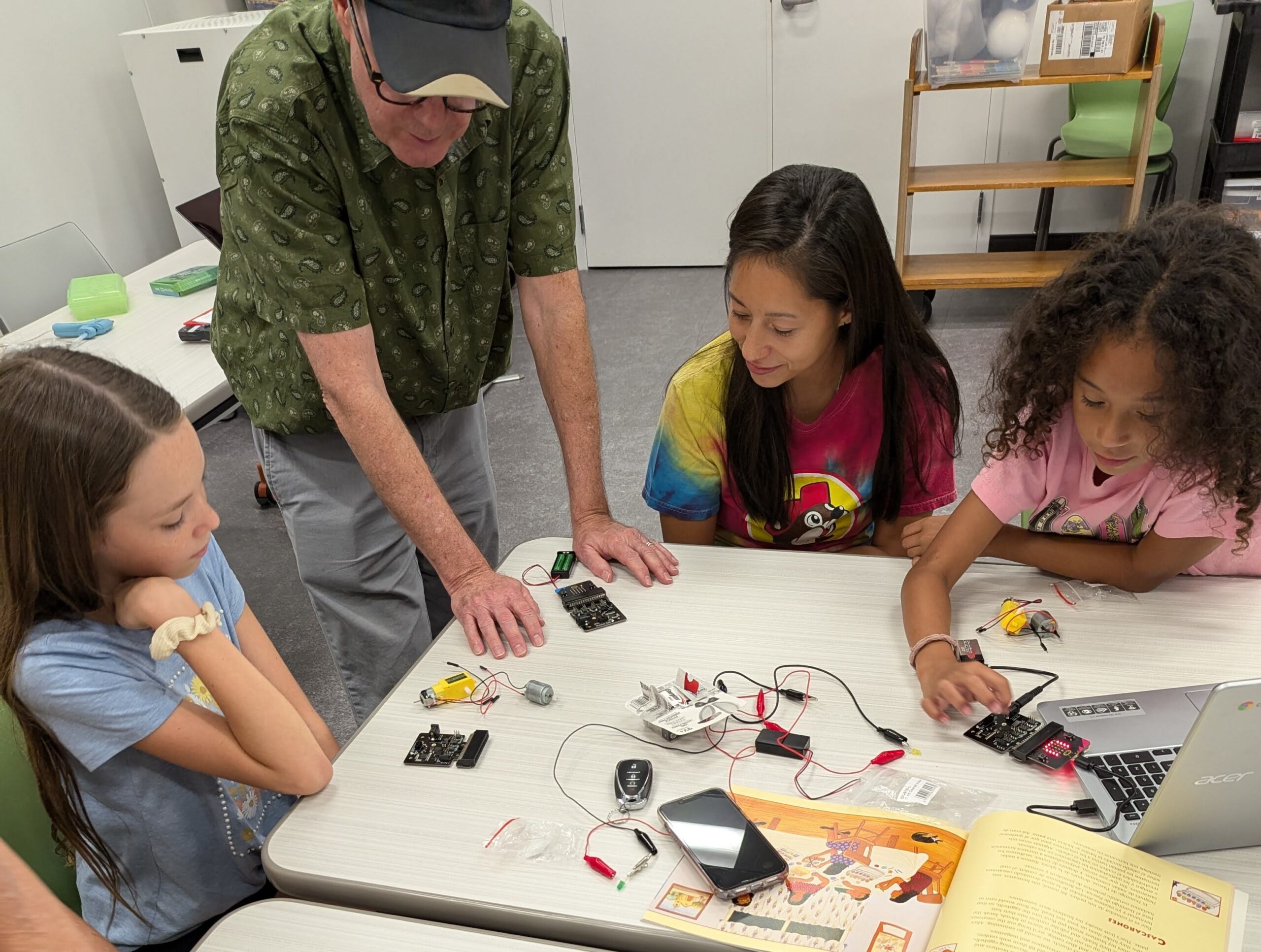
Even more powerful is what happens during the sessions. “The kids come in with ideas,” Ashley said. “But then something magical happens. The adults start having ideas too. Sometimes the kids are helping the adults.”
This shared experience creates a learning environment that extends far beyond the library walls. Families continue projects at home, especially with accessible tools like Scratch, a free programming language to make stories, games, and animations, and return to the library for support and next steps.
One Families Learning Together participant and Expressive STEM Centers Community Coordinator, Rebecca Licea-Vazquez, had this to say, “At first, I was hesitant to work with coding or robotics because I didn’t feel I could learn something new this late in the game. I’m happy to say I was wrong. My son has been interested in robots since he was a toddler. I’ve done my best to reassure him that he can learn anything he sets his mind to. At the playshops I realized the same is true for me. We never stop learning. And honestly, it’s helped us grow closer because he is telling me all his ideas, and I’m helping him create them. FLT is an investment in families and future careers for kids. My great-grandfather said, ‘La educacion sale cara, pero la ignorancia te cuesta mas—Education can be expensive, but ignorance will cost more.’”
Technology That Invites Exploration Through Playful Inquiry
The technology used in San Marcos is intentionally approachable and flexible. Programs incorporate tools like Scratch for coding, Micro:bit and Makey Makey for hands-on computing, and Kibo robots that allow even the youngest learners to program without screens.

But the tools are not the focus. “The immersive experience of learning through play is what keeps people coming back,” Ashley said.
Programs like the Kids Robot sessions introduce children ages three to five to early coding concepts through storytelling and physical interaction. Meanwhile, the One Water Sandbox series blends science, engineering, and creativity, challenging families to explore water conservation through coding, models, and collaborative problem-solving.
These experiences are facilitated by university students, creating a dynamic learning environment that connects higher education with the community in meaningful ways.
The Power of Partnership
The collaboration with Texas State University is at the heart of this model. What began as a shared idea has grown into a robust partnership supported by a National Science Foundation grant through the Expressive STEM Centers initiative.
University students serve as facilitators. Researchers study the impact of the program. And the library provides the space where community learning comes to life. Dr. Justice’s original vision was simple but powerful. He did not want these ideas to stay on campus. “The library was the obvious choice,” Ashley said.

That decision has created a bridge between academic research and everyday learning, making STEM more accessible to families across San Marcos.
A Model Any Library Can Try
While the San Marcos program includes advanced tools and grant support, Ashley is quick to point out that the core model is not dependent on technology or funding levels. “This can be scaled up or down,” she said. “The real key is families working together.”
At its heart, the program is about creating space for exploration, persistence, and those breakthrough moments. “You see a child working through a problem, getting frustrated, and then suddenly it clicks,” Ashley said. “They find a solution and a path forward. That moment isn’t dependent on any specific technology. It can happen anywhere.”
For Texas libraries looking to expand STEM programming, that is the takeaway.
Start with curiosity. Invite families in. Build partnerships where you can. And focus on creating experiences that last beyond a single session. Because when learning becomes something families do together, the impact reaches far beyond the program itself.

