At McKinney Public Library, data isn’t an afterthought; it’s the backbone of decision-making, from library hours to programming to collection development. Director Spencer Smith and his team have made a habit of asking, What do the numbers say?, and the results speak for themselves.
Shaping hours to match community needs
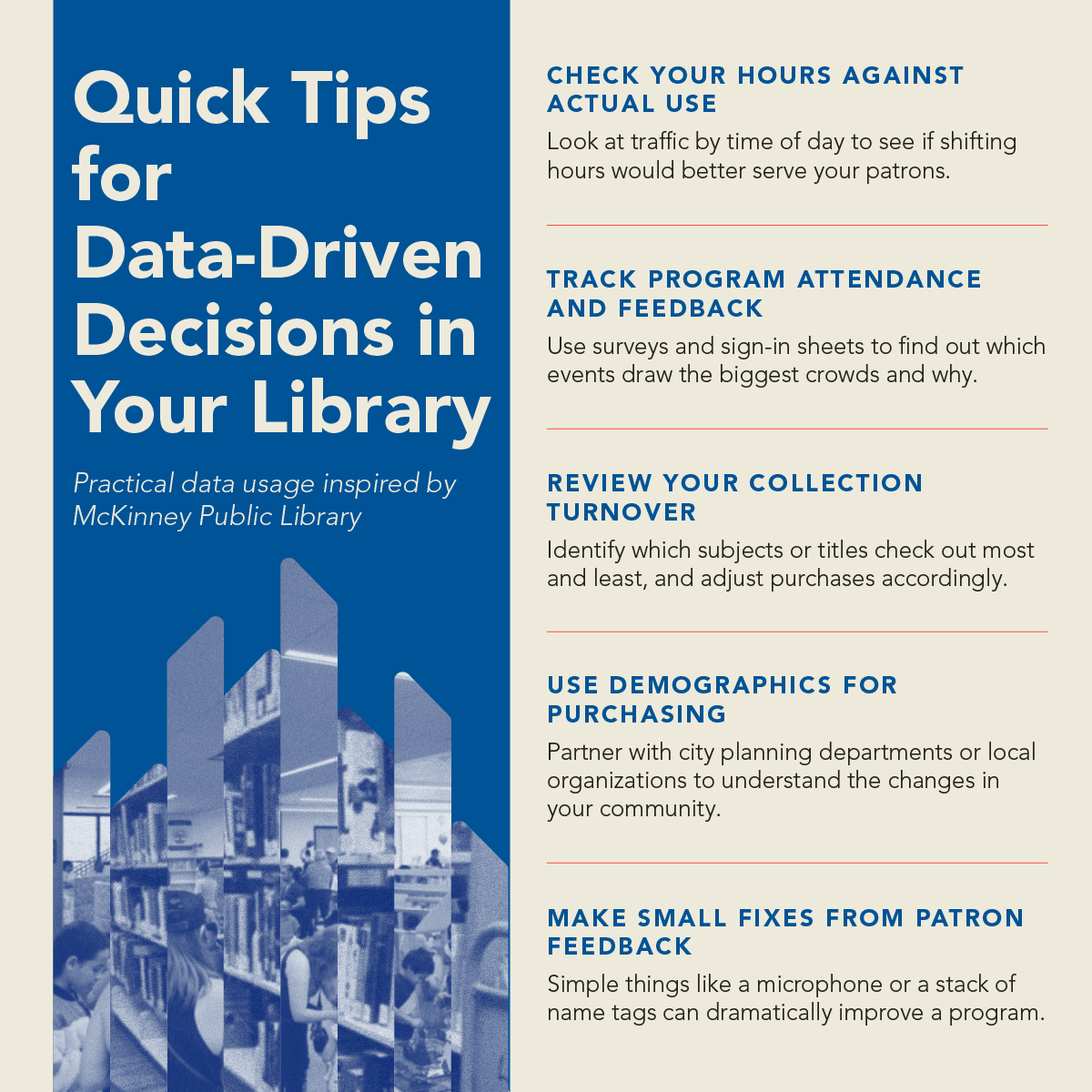
Before renovating the downtown branch, Smith and his team analyzed usage patterns. They discovered something surprising: from 7:00 – 9:00 p.m., staff outnumbered patrons, while mornings had untapped potential. The library shifted to open at 8:00 a.m. instead of 10:00 a.m., and attendance from 9:00 –11:00 a.m. surged. “People were coming in to grab their holds, use computers, and get what they needed before work,” Smith explained. “Data showed us we could serve more people earlier in the day.”
Collections with a purpose
Data drives what stays, what goes, and what gets purchased. By tracking turnover rates, age of materials, and subject popularity, the library identifies underperforming areas and invests in high-demand ones. For example, plant-based cookbooks are soaring in circulation, so the library purchases more, while outdated titles get replaced. Demographic data also shapes the collection as recent growth in McKinney’s South and East Asian communities prompted the addition of Hindi and bilingual Hindi/English books.
Programming guided by numbers
McKinney uses Metabase, an open-source data visualization tool, to track program titles, attendance, and survey feedback. “We can see trends, like our chess club pulling 100 people on weekends—so we adjust accordingly,” Smith said. The library focuses on fewer, bigger programs when attendance patterns shift, maximizing staff time while still drawing large crowds.
The aforementioned demographic data also led to more programming to coincide with South and East Asian holidays. “We did a Vietnamese night market and a lunar festival. Those cultural events are great and draw big crowds.”


Smith also urges patrons to register and sign in for events to get more data. He also sends out surveys afterward to gather more information to inform future programming.
Qualitative data also matters. The staff got some feedback after a baby program, and Smith recalled a request for name tags, so they added them—not for the babies, but for parents to connect. The name tags helped the new parents break the ice. “It’s about building relationships,” Smith said, “And data, both numbers and feedback, tells us what’s working. A simple thing like having nametags made a huge difference for the patrons.”
When the library tried to start a teen mystery club, they had a tough time getting it off the ground. “The data showed us that the average age for mystery borrowers was far beyond retirement, and the majority were women. Our collection was geared towards them.” That information allowed them to pivot towards books that would appeal to teens.
In another program, patron feedback informed Smith that having a microphone would have improved the experience. When staff take the time to consider this data thoughtfully, the library offers better service, and the patrons benefit from it.
More Than Just Books
Data influences everything from computer printing policies to large-scale investments. When a new planetarium was projected to generate 100,000 additional annual visits, the library used those figures to justify adding staff positions. “Sometimes data doesn’t answer the question,” Smith said, “But it gives you the right question to ask.”
Smith hopes other Texas libraries embrace the possibilities. “We share our live statistics right on our website,” he said. “It’s transparent, it’s ongoing, and it helps us stay accountable to our community.”
Whether it’s tweaking hours, refining a program, or planning for a growing population, McKinney Public Library proves that when libraries use data well, they serve people better. As Smith puts it, “I could talk about data all day long… some of my best friends are spreadsheets.”


